
The relicensing of the Conowingo Dam is only opportunity in the next 50 years to get conditions to restore the Susquehanna River and protect the Chesapeake Bay and get meaningful pollution reductions at Conowingo Dam.
The Conowingo Dam is owned and operated by Constellation (formerly Exelon Generation Company, LLC) and its federal license expired in 2014. Constellation sought a new 50-year license from the Federal Energy Regulatory Commission (FERC). Under Section 401 of the Clean Water Act, the State of Maryland had to issue a Water Quality Certification, certifying that the project will meet state water quality standards before FERC can grant a new license.
Waterkeepers Chesapeake has been working with Lower Susquehanna Riverkeeper and Earthjustice since 2013 to hold Constellation accountable for its fair share of the dam cleanup. During the confidential mediation on the revised water quality certification and final settlement agreement, Chesapeake Legal Alliance provided counsel and expert advice.
Historic Conowingo Dam Agreement
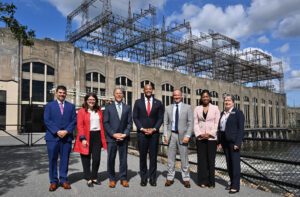
On October 2, 2025, Governor Wes Moore announced a settlement agreement between Waterkeepers Chesapeake, Lower Susquehanna Riverkeeper Association, Maryland Department of the Environment (MDE), and Constellation Energy, and terms of a revised Water Quality Certification for Conowingo Dam. Constellation has agreed to fund and implement operational improvements and environmental projects to meet enforceable water quality standards by reducing and mitigating the impacts associated with the dam’s discharge and operation on the Susquehanna River and the Chesapeake Bay and its tributaries. The agreement – negotiated in partnership with Waterkeepers Chesapeake and Lower Susquehanna Riverkeeper Association – clears the way for the re-licensing and continued operation of the dam’s hydroelectric facility on the Susquehanna River.
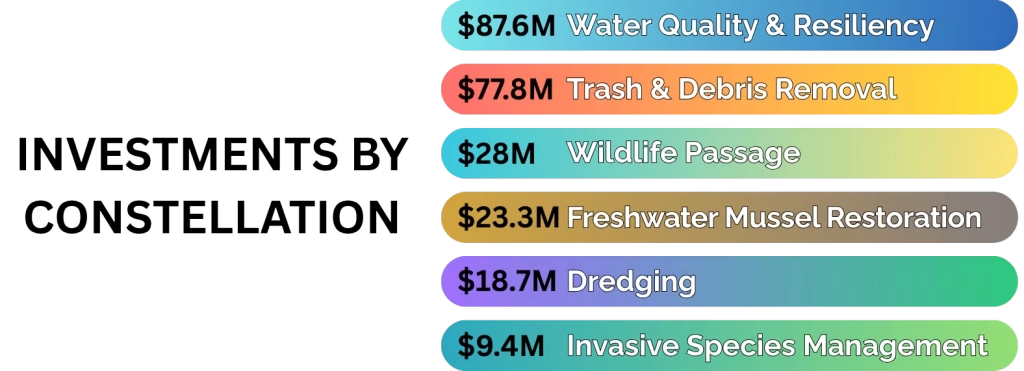
The terms of the agreement include operational improvements and upfront and ongoing annual payments, valued at $341 million, for water quality and resiliency projects, trash and debris removal, wildlife passage, freshwater mussel restoration, dredging, and invasive species management. Lower Susquehanna Riverkeeper Association and Waterkeepers Chesapeake have an ongoing role in aspects of the implementation of the certification and settlement agreement going forward for the next 50 years in partnership with Maryland Department of the Environment. Learn more.
Historic Court Decision

In June 2021, Waterkeepers Chesapeake, Lower Susquehanna Riverkeeper and Sassafras Riverkeeper at ShoreRivers, represented by Earthjustice, and joined by Chesapeake Bay Foundation, challenged FERC’s 50-year dam license. On December 20, 2022, the U.S. Court of Appeals for the District of Columbia Circuit issued an opinion vacating the Federal Energy Regulatory Commission’s (FERC) licensing of the Conowingo Dam and remanded it back to FERC. In its decision, the court agreed with our argument that FERC exceeded its authority when it approved a 50-year license without including the Water Quality Certification that Maryland issued in 2018.
With this decision, the Maryland Department of the Environment (MDE) restarted the administrative reconsideration process that began in 2018 when Constellation, Waterkeepers Chesapeake and Lower Susquehanna Riverkeeper requested reconsideration of the Water Quality Certification (WQC). In 2023, MDE established a reconsideration process with a goal of creating a legally durable WQC based on the best science. The reconsideration process included three components: 1) MDE conducted a top-to-bottom review of all the available science; 2) MDE sought public input from June 30 to August 1, 2023, as well as re-briefs and submissions from all the parties in the Reconsideration process, to solicit newly available data, science or information related to water quality standards or impacts since the first WQC was issued in 2018; and 3) A confidential mediation process began in spring 2024 with MDE, Constellation, Waterkeepers Chesapeake and Lower Susquehanna Riverkeeper Association.
Background
The State of Maryland issued its Water Quality Certification on April 27, 2018, and Exelon sued the State on May 25 in federal district court, challenging the state’s authority to require any pollution reduction from upstream sources. On July 20, 2018, Waterkeepers Chesapeake and Lower Susquehanna Riverkeeper, represented by Earthjustice, filed a motion to intervene in a federal court action regarding the relicensing of the Conowingo Dam, supporting the State’s authority under the Clean Water Act. This motion to intervene was denied.
In addition, Waterkeepers Chesapeake and Lower Susquehanna Riverkeeper Association filed an administrative appeal on June 8, 2018, urging the MDE to reconsider its water quality certification for the Conowingo Dam arguing that it was missing several key elements. Exelon also filed an administrative appeal based on different reasons. On October 29, 2019, MDE and Exelon announced a settlement agreement made behind closed doors that fell far short of protecting Maryland’s waterways. It required the state to waive the Water Quality Certification it issued in 2018, without any details on how the agreement will protect water quality. In addition, it provided grossly insufficient funds to deal with the risks that Conowingo operations pose to the Susquehanna River and Chesapeake Bay, and lacked concrete assurances that the actions under the agreement will actually be fulfilled by Exelon. This agreement was submitted to FERC to be incorporated into the new license.
In March 2021, FERC approved Exelon’s Conowingo relicensing for the next 50 years. This license included the extremely flawed 2019 settlement agreement between MDE and Exelon. The timing of the relicensing decision derailed our efforts to pass bi-partisan emergency legislation that would have stopped the settlement agreement. In May 2021, the EPA’s evaluation of the Conowingo Watershed Implementation Plan (CWIP) noted that even though the financing plan is still in development, there’s a lack of confidence that this plan can be carried out without clear public funding sources identified. The earliest CWIP framework documents included Exelon as the likely source for funding the plan.
To learn more, also visit Lower Susquehanna Riverkeeper Association.
About the Conowingo Dam
The Conowingo Dam is located on the Lower Susquehanna River about 10 miles upstream from where it flows into the Chesapeake Bay at Havre De Grace, Maryland. As a hydropower dam, Conowingo has replaced a free-flowing section of the Susquehanna River with a 14-mile-long, 9,000-acre reservoir. This fundamentally alters the river’s ecology.
The dam supplies power for the Muddy Run pump and storage facility, and provides cooling water to the Peach Bottom Nuclear Facility, all operated for a profit by Constellation (formerly Exelon). During peak power usage periods, the dam can produce up to 572 megawatts (MW) of electricity.
Ever since the dam was built in 1928, it has changed seasonal river flow; blocked the migration of shad, herring, eel and other fish; destroyed fragile aquatic habitat; devastated the shellfish communities that naturally filtered the Susquehanna’s water; killed millions of fish caught in hydroelectric turbines; and altered the river’s natural ability to transport nutrients and sediment. Because Constellation (formerly Exelon) did not maintain the dam’s reservoir, nearly 200 million tons of sediment pollution accumulated behind the dam. During major floods caused by large storms, powerful floodwaters can scoop out or “scour” the stored nutrient-laden sediment behind the dam and send that downstream to the Lower Susquehanna and the Chesapeake Bay. Up to 6 million pounds of Nitrogen and 260,000 pounds of Phosphorus pollution from the dam enter the Chesapeake Bay annually.

Conowingo Dam Settlement — A Big Win for Clean Water on the Eastern Shore!
Waterkeepers Chesapeake & Lower Susquehanna Riverkeeper Secure Historic 50-Year Conowingo Dam Agreement
Governor Moore Announces Historic Conowingo Dam Agreement to Promote Landmark Chesapeake Bay Restoration Efforts and Supercharge $3.2 Billion Bay Economy
Reflecting on Our Clean Water Victory — A National Precedent

Please consider a donation to turn hard-won commitments into cleaner water and lasting change
 EN
EN  ES
ES