

Water monitoring is at the heart of our mission as Waterkeepers. By gathering information about the conditions of our local rivers, streams, and coastal waters, such as bacteria levels, salinity, pH, and dissolved oxygen we gain crucial insight into the health of our ecosystems and the threats they face. Our monitoring efforts extend to areas that may otherwise go untested, including places where communities fish, swim, or paddle. In doing so, we not only protect public health but also fill critical data gaps left by limited public monitoring programs. Waterkeepers also test for contaminants like PFAS the so-called “forever chemicals” and other toxics from industrial or wastewater sources, ensuring that potential dangers are identified and addressed before they become long-term hazards.
Over the past several years, our data has revealed a consistent pattern: key pollutants such as phosphorus, sediment, chlorophyll a, and bacteria continue to threaten water quality across all monitored watersheds. These pollutants degrade clarity, deplete oxygen levels, and disrupt aquatic life especially in areas where natural defenses like submerged aquatic vegetation are already in decline. Climate change has only magnified these challenges. Increased rainfall leads to more stormwater runoff, which carries nutrients and contaminants into waterways, while prolonged dry spells, though occasionally improving water clarity, shift salinity and temperature levels in ways that harm sensitive species. Seasonal fluctuations and rising sea levels have begun to transform the very nature of these ecosystems, challenging the resilience of both habitats and human infrastructure.
Monitoring these changes year after year helps us understand the long-term impacts of climate variability and human activity. It also enables us to act by advocating for better policies, informing restoration efforts, and empowering communities with reliable data. Each water sample we collect and analyze strengthens our ability to respond with science-based solutions. As the pressures on our watersheds grow, so too does the value of consistent, local water monitoring. This work not only defends our waterways from pollution, but also ensures that future generations can enjoy clean, safe, and thriving waters.
Our Waterkeepers’ Monitoring Efforts in 2024
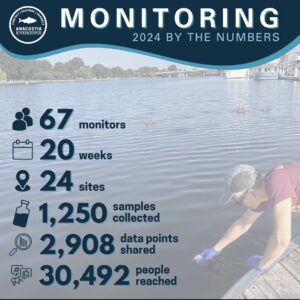
The Anacostia Riverkeeper’s Water Quality Monitoring Program provides data on 24 sites in the District of Colombia, Montgomery County and Prince George’s County. Built in 2019 and based on community science, the program recruits dozens of volunteers who are trained to sample water. For 20 weeks from May to September every Wednesday morning water quality samples and measurements are collected. Current river conditions can be found on this map. ARK recently released their 2024 Citizen Science Water Quality Monitoring Reports for the District of Columbia and Maryland. These reports study six parameters: bacteria, dissolved oxygen, turbidity, pH, water temperature and air temperature.
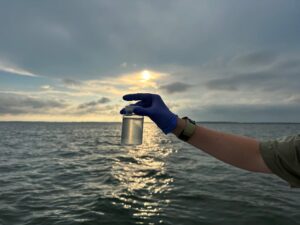
The Assateague Coastal Trust, home of the Assateague Coastkeeper, conducts its Tidal Waters Monitoring Program May through September. They share their results via Facebook as well as the Swim Guide and Water Reporter apps. Other parameters such as pH, dissolved oxygen, turbidity, and conductivity are tested at 11 sites. A live map is available at Water Reporter. You can report pollution here Report Water Pollution | ACT.
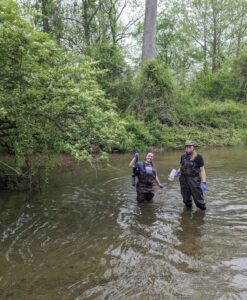
Blue Water Baltimore, home of the Baltimore Harbor Waterkeeper, publishes current water conditions on their Baltimore Water Watch, including an interactive map with data from 51 collection sites. The map follows state guidance to determine if a site is meeting state-mandated water quality standards at any given time. The 2024 water quality report card summarizes the water quality impacts and what they will be focusing on for year 2025. For years 2009-2024, they have used academic scoring to communicate about water health in the Baltimore region, since that was more intuitive for people to understand what an “A” or “F” grade equates to on a percentage scale. For the year 2025, they will be realigning the scores with the EcoCheck scale without assigning letter grades. The change is to allow accurate communication without the confusion about the academic vs quintile grade systems.
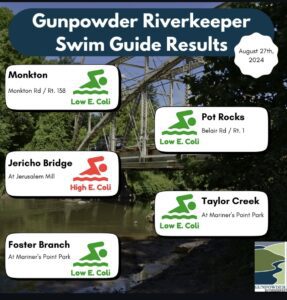
Gunpowder Riverkeeper provides monitoring in Baltimore and Harford counties along the Gunpowder and Bush River Watersheds. In partnership with Community Environmental Laboratories, an EPA-certified water testing laboratory located in Harford County, Gunpowder Riverkeeper conducts sampling at various access points along the river for their respective E. Coli levels. Since 2019, results have been posted to Swim Guide to inform the public on where they can recreate safely as well as indicate possible stormwater or point-source pollution.
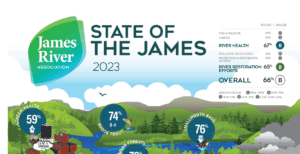
James River Association, home of the James Riverkeeper, monitors 29 sites, with data publicly available at James River Watch, including a river conditions map that communicates bacteria levels and other river conditions to the public during the summer. The most recent State of the James report uses 2023 data to demonstrate ongoing efforts to bring the James River back to full health. It is published every two years.
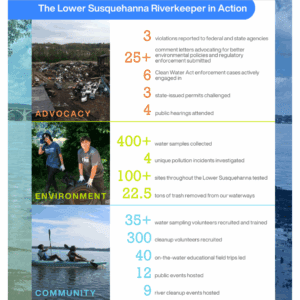
The Lower Susquehanna Riverkeeper launched the Water Watchdog Weekly Bacteria Monitoring Program for the Lower Susquehanna River Watershed in 2023. The purpose of this program is to inform people when popular public river/creek accesses are safe for recreating, or not. The program runs every Thursday, starting on Memorial Day through Labor Day, at 15 sites throughout the watershed. Results are shared every Friday at the homepage, via social media, and on the SwimGuide App.
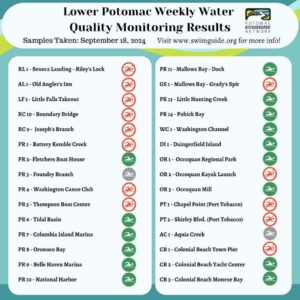
Potomac Riverkeeper Network, home of the Upper Potomac, Potomac, and Shenandoah Riverkeepers, monitors 29 sites in DC, Virginia and Maryland through its community science monitoring program with over 100 trained volunteers. The program has been active since 2019. A public map is available on their monitoring home page, and they share current water quality results and information on the safety of the public access sites on SwimGuide and Facebook every Friday between May and the end of September. The 2024 Swimmable Potomac report found that monitoring sites passed public-health based water quality standards 71 percent of the time.
ShoreRivers, home of the Chester, Choptank, Miles-Wye, and Sassafras Riverkeepers, uses staff and volunteer citizen scientists to monitor water quality throughout these rivers as well as the Bayside Creeks and the Eastern Bay.

The 2024 report card is produced with data conducted weekly by the volunteer SwimTesters, as a part of the Swimmable ShoreRivers program. Their 2024 water quality results showed Choptank, Miles, Wye, and Eastern Shore bank rivers have declined in water quality compared to 2023 results. While Sassafras and Bayside 2024 overall water quality was the best score it had been in more than eight years. The start of the 2025 season seems to be concerning for what year will be like, with potential for early-season algae blooms and high levels of chlorophyll.
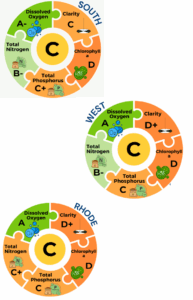
The Arundel Rivers Federation, home of the South, West, and Rhode Riverkeeper, conducts seasonal water quality monitoring programs to collect tidal water quality data at stations distributed across their region as well as monitoring bacteria levels at community sites. Data is shared every Friday during the season on Swimguide. They have released a 2024 South River Report Card and Bacteria Monitoring Report.
Severn Riverkeeper’s water quality monitoring program collects data at multiple stations in the Severn River including temperature, dissolved oxygen, conductivity, salinity, and turbidity at 8 sites, with an emphasis on monitoring creeks near stream restoration sites, Round Bay and the upper Main Stem near the mouth of the Severn Run headwaters. The monitoring season runs from May through October.
The Middle Susquehanna Riverkeeper Association, home of the Middle Susquehanna Riverkeeper, is conducting quarterly surface water sampling in Montour County waterways for the next 29 years, following a settlement agreement with Talen Energy over contamination from toxic coal ash sites. Testing results are shared publicly on their website.
Get Involved!
Most Waterkeepers are looking for volunteers to assist in water quality monitoring. And all Waterkeepers have pollution reporting hotlines (phone numbers, online forms, etc) to report any concerns from the general public on pollution in their waterways. Download the Swim Guide or the MyCoast app for river, coastal and beach updates. Follow the Waterkeepers on social media and check out their websites for updates, and ways to volunteer.
 EN
EN  ES
ES