
Waterkeepers Chesapeake submitted comments on behalf of its 16 Waterkeeper members and Chesapeake Legal Alliance on EPA’s plan to remove Clean Water Act protections for most wetlands and seasonal streams across the country. This new rule would accelerate the destruction of wetlands, worsen water quality, and put the health of our communities — and the drinking water they depend on — at risk.
 The proposed rule ignores science and common sense. All waterways are connected. Wetlands filter pollution from rivers, lakes, and streams, and many streams are drinking water sources. Excluding these water bodies from protection threatens all connected water bodies with pollution. The EPA’s own estimate indicates the proposed rule would leave more than 80% of mapped wetlands in the continuous U.S. unprotected against pollution and destruction. And despite the fact that water flows across state lines, the proposed rule completely eliminates interstate waters as a category of protected waters.
These waterways also lose the public’s right to enforce the Clean Water Act. Without oversight, these waters face increased risks from pollution, threatening clean drinking water, recreation, fisheries, and aquatic life.
EPA says they must revise the Clean Water Act’s definition of “waters of the United States” (WOTUS) in order to lower the cost of doing business. Yet, this new rule causes more uncertainty and confusion. Eliminating clean water protections would be a disaster for the economy when factoring in higher water treatment costs and utility bills, exorbitant cleanup costs, flooding disaster damages, healthcare expenses, reduced agricultural production, and lost business opportunities. The new rule puts a greater burden on state agencies and makes enforcement harder.
We understand, and have seen first-hand, how important a broad definition of “waters of the United States” is to the functioning and effectiveness of the Clean Water Act to protect and restore water quality across the country. The Clean Water Act is the bedrock of our work to protect rivers, streams, lakes, wetlands, and coastal waters for the benefit of all people and communities that depend on clean water for drinking, subsistence fishing, recreation, their livelihoods, and their survival.
The Gunpowder River watershed is an example of the complex interconnections between streams and wetlands that span two states. The Gunpowder drains a 450 square mile watershed area that starts in a complex of seeps and springs in York and Adams counties in Pennsylvania, and then travels across Carroll, Baltimore and Harford counties in Maryland. It comprises 217 miles with designated and existing uses of cold water and drinking water supply streams. The new definitions posed in WOTUS threaten these uses, notably, the interstate water exclusion, and the loss of protection under WOTUS of stream segments without beds or banks.
The Gunpowder watershed exemplifies the connection with upstream surface water sources and quality drinking water for 1.5 million Baltimore Metro-Area residents. Two dams, Pretty Boy and Loch Raven, that if the new definition holds, “obstruct water flow” and so by the new definition would leave the streams and rivers in over 400 square miles of watershed area in the Upper watershed unprotected by WOTUS. In addition, there are over 1,192 acres of isolated wetlands within the Gunpowder and Bush Watersheds that would lose protection under the new rule. These wetlands are habitat for Bog Turtles protected under the Endangered Species Act.
While unnecessarily attempting to propose exclusions and new definitions, the proposed rule creates confusion and uncertainty. The term “wet season” is included within one proposed definition but is itself not defined. The use of the term “wet season” is not culturally or statutorily relevant in the Chesapeake watershed states and therefore does not account for the regional difference in weather and other environmental patterns. Snow melt and rainfall vary immensely across our region. Relatively permanent is not necessarily six to nine months of a “wet season” in our region, rather relatively permanent water bodies flow consistently after every major rainfall event year-round. The definitions provided in the proposed rule are arbitrary conditions that are not realistic for how wetlands and streams function in our climatic conditions.
A clear example is a basalt mining company in Fairplay, PA that was discharging into Miney Branch, a headwater ephemeral stream that only flows during rain events into the Monocacy River. The discharge was composed of very fine suspended solids that polluted the stream for miles after every rain event and filled in the stream bottom wiping out valuable macroinvertebrates that sustain fish. A sports fishing club just downstream had trouble maintaining fish populations in a connected pond. In 2019, Upper Potomac Riverkeeper filed a notice of intent to sue under the Clean Water Act. The company did not challenge their standing and decided to work with them to put in place a sand filtration system that reduced the total suspended solids by 90%. The system is still in use today. Under the new proposed definition, this stream would not have been protected under the Clean Water Act, precluding Upper Potomac Riverkeeper from challenging the company and the pollution could be continuing to this day.
A clear WOTUS definition that protects the integrity of the nation’s waters greatly benefits the public, farmers, businesses, landowners, and state and tribal governments in myriad ways, including reduced compliance and production costs. On Maryland’s Eastern Shore, the proposed rule would strip federal protections for many streams and wetlands. Those include seasonally dry wetlands like the Delmarva Bays; small streams that treat stormwater from farm fields and towns; interstate headwaters of the Choptank, Chester, and Sassafras rivers; tidally influenced ditches like those in Dorchester, Talbot, and Queen Anne’s counties; and groundwater reservoirs that deliver most of the excess nitrate pollution impacting these rivers. The proposed rule will cause increased flooding, reduced habitat for waterflow; fewer restrictions for developing forests, wetlands, and streams; and less mitigation to account for the loss of those sensitive, yet highly valuable, ecosystems and watersheds.
These areas are not only valuable to support healthy environments, but they are also the backbone of the local economy on Maryland’s Eastern Shore, sustaining industries like commercial and recreational fishing, boating, tourism, hunting, outdoor recreation, and other natural resource-based businesses. According to the Bureau of Economic Analysis, in 2023, the outdoor recreation industry in Maryland generated nearly $10 billion and employed just under 3% of the state’s total employees, with room to grow. Reducing protections of wetlands and streams puts both Maryland’s environment and economy at risk.
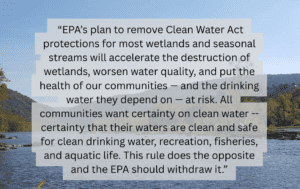
Constantly reinterpreting this more than 50-year-old law to suit the most recent bureaucratic objectives and justify the adoption of yet another new WOTUS definition creates uncertainty, benefits no one, and endangers everyone. All communities want certainty on clean water – certainty that their waters are clean and healthy and that when they turn on their taps, the water that comes out is safe. This rule does the opposite and the EPA should withdraw it.

 EN
EN  ES
ES